When one thinks of the former US base Camp John Hay, hiking is not usually one of the first activities that come to mind. It's more of the luxurious accommodations at The Manor, the golf course designed by Jack Nicklaus, the restaurants, the duty-free stores...heck, the mini-golf course even.
But i had stumbled upon a blog that talked about forest hiking trails inside CJH. And there apparently were two of them. I'm not much of a hiker, but this trip was supposed to be a relaxing one away from maddening crowds and tourist spots; and despite initial apprehensions ("ummm, where does one pee if one needs to pee? what if i encounter a huge snake blocking the path? may cellphone signal ba dyannn?"), we said let's gooo!
The shorter, more popular trail is known as the Eco-trail, and can be accessed across Le Monet Hotel on one end, with its other end near Gate 3, the camp's former main entrance.
Our activity today was to walk along the other trail, called the Yellow Trail. This is a longer, winding hiking trail through the pine forest on the southern and eastern
regions of Camp John Hay.
The Yellow Trail has been renamed by the Dept of Tourism, and is now known as the Camp John Hay Forest Bathing Trail. According to the site Ikot.PH, this was opened to the public in November 2018. The underlying idea was to introduce the practice of shinrin-yoku as a tourism and recreational activity in Baguio.
You might ask, what's this? Well, i will explain not-so-grumpily: shinrin-yoku literally translates to ‘forest bathing’ (after the Japanese words shinrin, which means ‘forest’; and yoku, which means ‘bath’).
Basically, it is the concept of taking a recreational trip into the forest for
meditation, relaxation, therapy, and well-being. There have been some anecdotal studies showing how this is helpful in lowering blood pressure, boosting one's mood, and the like.
After some searching, we found our starting point! Above is the Torii marking one end of the Forest Bathing Trail (i.e. Point 1). It
is situated on the far end of the parking lot on the western slope
of Scout Hill.
Here below is a list of Do's and Dont's before one enters the trail.
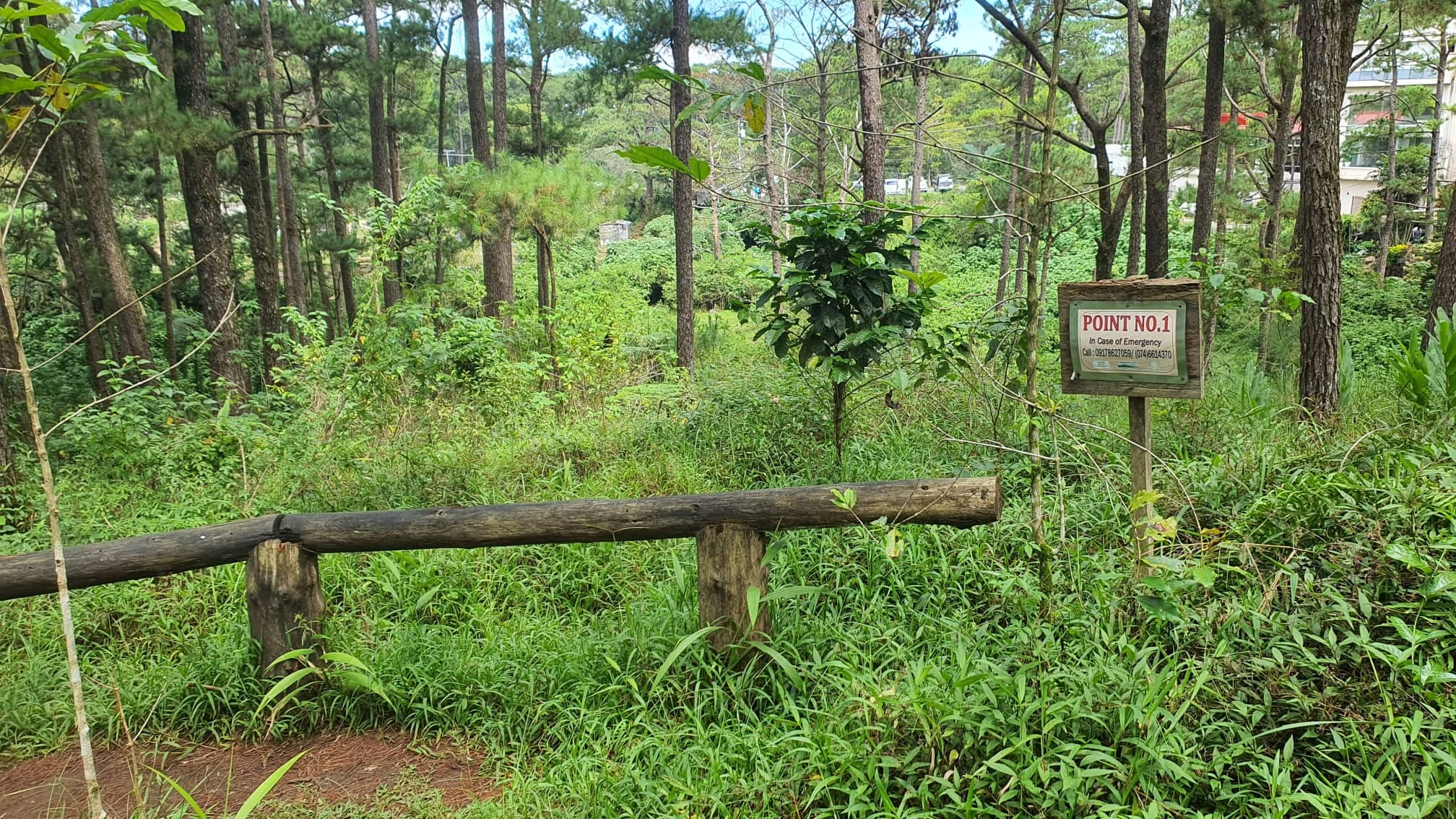
The forest bathing trail is divided into 9 checkpoints, with markers for each point. So off we go! (Aptly, the song 'No Turning Back' by Gui Boratto was playing on my mind)
Not sure what the purpose of this one below is:
Meandering at a leisurely pace, with silence except for the faint chirps of birds, we reached Point 2 shortly.
This is one of the flatter, more wide-open portions of the trail.
We bumped into this kid riding his bike along the trail (despite the rule expressly forbidding it). Thankfully, he turned back soon after. It would have been foolhardy to bike at the narrower, cobbled parts of the trail where one's frantic screams while dropping down the precipice will surely echo like a chamber of hellos hello hello hello :-D
Oh look, wind chimes! Nice! I wondered briefly what it would be like to be on this trail with an overcast gray sky, and a fierce wind blowing amidst the rumbles of an impending storm, just to hear how the wind chimes would sound like. Sana next time! (Oh wait, there might not be a next time ;-D)
We crossed paths with other folks walking the trail, coming from the other direction (they started at the opposite end, Point 9); and there is something about being relaxed and being outdoors that makes one more convivial, and invariably 'hellos' are exchanged amongst fellow hikers.
This guy (see that person in blue?) was jogging briskly on the path, and came from behind us. Woww!
Still some old vestiges of the former owner remain. Check the sign "Private Property: United States of America" that have been left untouched.
We eventually reached the midway point, i.e. Point 5. It is distinguished by a paved road and a guard crossing ("Residence: United States of America"). The guardhouse was shut, and looked like it had not been in use for many years, if one were to go by the
cobwebs attached to its door.
In some parts (like below), the path is less delineated; and one has to really watch one's step.
Here and there, there were folks on the trail who had the time and talent to stack rocks on top of one another, with pretty results:
This one below was my favorite. Nice formation, with a killer view point to boot. It was an ideal pit stop/resting place to just take it all in. Remember, the idea of forest bathing was to walk/hike leisurely....this is not meant to be The Amazing Race.
Signages (both the new 'Forest Bathing Center' and old 'Yellow Trail') along the way, reassuring one that one has not gotten lost hehe!
Obligatory hiking photo of moi, lest my friends think i'm too lazy to actually hike and am faking all of this. LOL :-D
Point 8, already!! Okay! We are nearing the final leg of our journey!
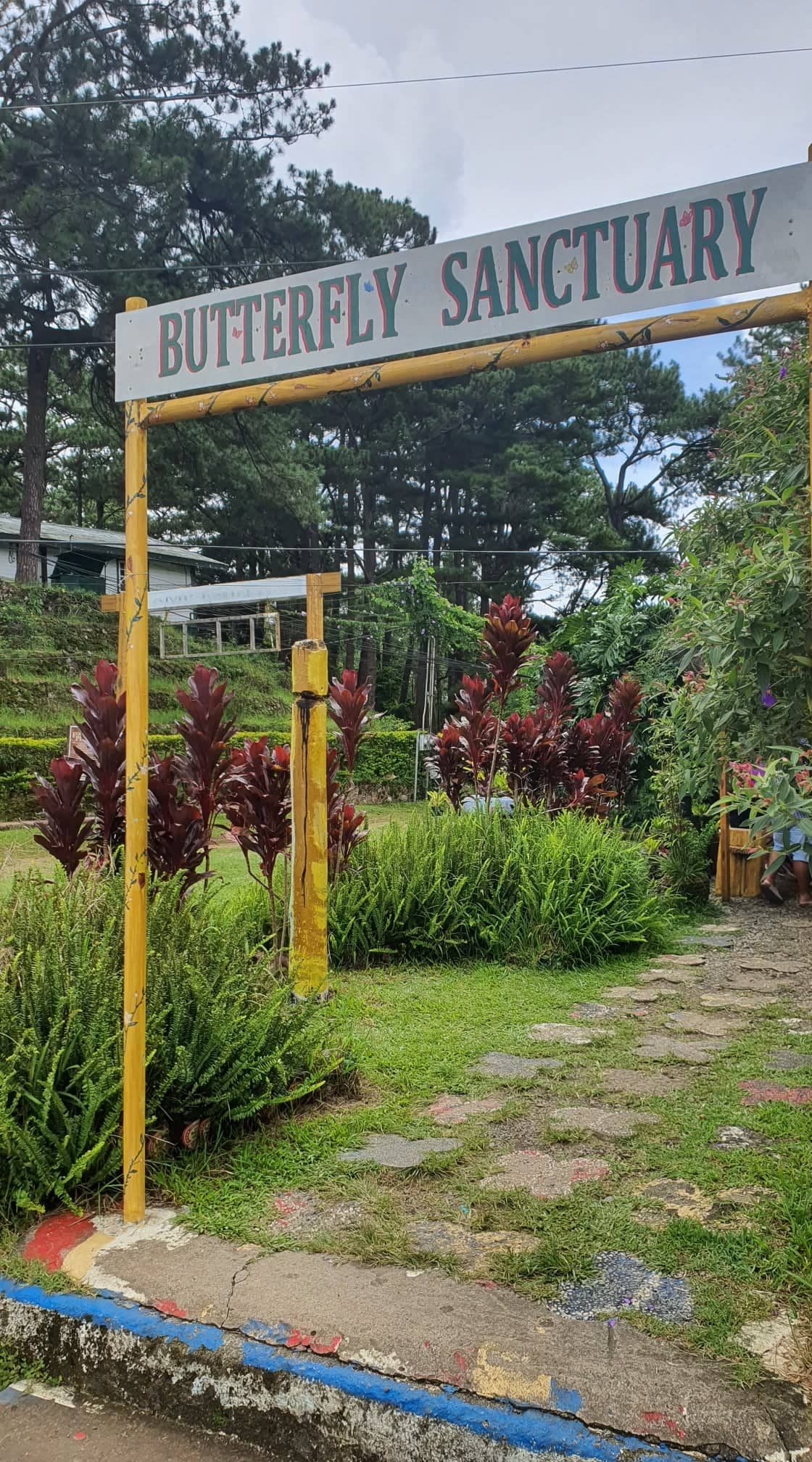
We passed by a gymnasium-like structure, which seemed to be the zipline facility of CJH. Thereafter, there was a narrow, muddy stretch of path. Once you see this signage of the Butterfly Sanctuary, the end of the path will literally be in sight.
And this below is the sign that you have completed the forest bathing trail....except that the signage seems to be missing (stolen? being repainted?).
But don't worry, beside it is the Butterfly Sanctuary, and they have a proper sign. Right next to it is the Lone Star Cafe, and fronting it is the open area used for go-karting.
And just like that, after walking for 1 1/2 hours, we finished the trail! Emerging back to civilization (exag :D).
Mercifully, Point 9 lies just a few hundred meters away from our starting point, Point 1; and we were able to get back to our car in no time. Not before partaking of Baguio's famous strawberry taho from an ambulant vendor, of course.
A fitting denouement to our forest trail adventure, no? (actually i couldn't think of any other way to end this blog post sorry not sorry)
POSTSCRIPT: Some comments and observations about the Forest Bathing Trail:
a) When we reached Point 5, we realized we somehow missed the markers for Point 3 and 4. Likewise, upon reaching Point 8, we wondered where the markers for Point 6 and 7 were. Either we were not paying attention (not likely) or walking too fast (duh), but it just seemed weird to have missed seeing them.
b) To get the full experience, I really suggest to put away one's phone and watch, and resist the urge to check either of them. There's enough time to do that later on.
c) I had read online that there would be some sort of registration area, or at least, a person with a log book, even though the trail is free. But no. One just shows up and starts walking.
d) From my POV as a seldom hiker, there were some parts of the trail that surely could use a handrail or two, for safety purposes. [Paging DOT!]
e) Indeed, no toilet facilities anywhere along the trail. Not that we expected any. But one of us joked that a sari-sari store (selling softdrinks and Piattos and Juicy Fruit gum) in the midst of the path was the type of Pinoy thing that would be a cool and rather absurd thing to happen! :-D
For a full detailed account from a Baguio local, please check out:
https://phmillennia.com/along-the-forest-bathing-trail/